Swiss Inv
The Swiss-Inv inventory identifies and inventories the potential for reuse of building materials in construction projects. The inventory is based on...
See details

Here you'll find resources ranging from practical manuals to scientific studies that can help you with your reuse projects.
The Swiss-Inv inventory identifies and inventories the potential for reuse of building materials in construction projects. The inventory is based on...
See details
Whoever wants to build needs a binding and regulating contractual situation. When it comes to building with...
See details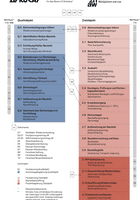
With the Cirkla-Alarme tool you can receive an automatic e-mail when a re-use item you're looking for is...
See detailsCirkla-Scan gives you one-click access to the national supply of reusable materials, including catalogs of platforms and...
See details
Author: Sarah Ackermann, Cirkla/intep; Dr. Daniel Kliem, Intep; Prof. Daniel Kellenberger FHNW, Prof. Margarete Olender FHNW, Samuel Held, FHNW (2025)
Language: German
This study examines the development of reuse in the construction sector and details concrete measures to support the transition to circular construction practices. It presents an analysis of recent developments, an overview of the regulatory framework, and a set of operational measures for industry stakeholders. The study highlights the potential role of reuse in improving resource efficiency, reducing environmental impact, and supporting innovation in construction. Beyond a simple overview of the current situation, it proposes a structured approach to gradually integrate reuse on a large scale.
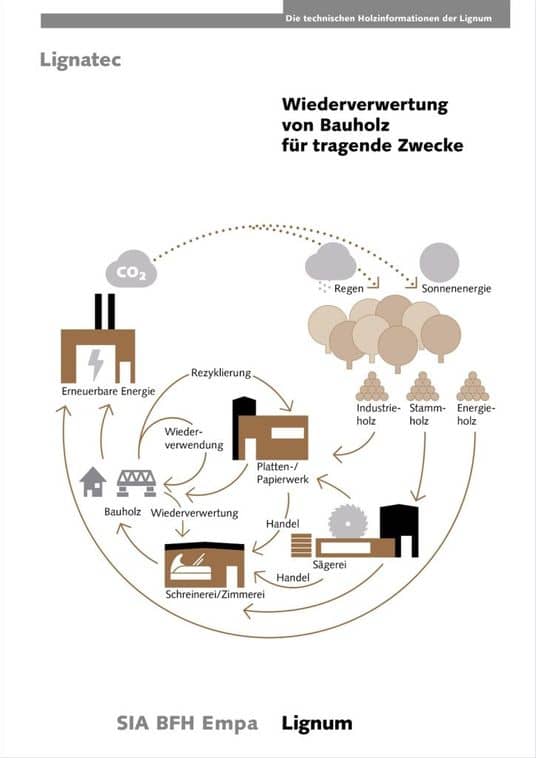
Author: Gunther Ratsch, Lignum / Specialist readers: Christoph Fuhrmann, Dipl.-Ing. in timber construction ETS/SIA, HESB-ABGC, Biel; Urs Luginbühl, Dipl.-Ing. in timber construction ETS, Luginbühl engineering office, Biel; René Steiger, Dr. sc. techn., Dipl.-Ing. in construction ETH/SIA, Empa, Dübendorf (2023)
Language: German, French
Recycling lumber extends the useful life of building materials and components. This conserves resources and reduces the environmental impact of producing new products. The Lignum publication provides information on the possibilities for recycling solid wood and glued solid wood products in the construction industry.
Vanessa Feri (2023) Language: German
The research report "Learning from the pioneers of the circular economy" provides an insight into the reuse of building components. The experiences of the players involved show that practical experience of deconstruction has a transformative effect and provides insights into reversible construction. The report highlights the challenges and opportunities of reusing building materials, stresses the importance of early training and emphasizes cooperation between the various players. Organizational aspects such as scheduling and storage space, as well as new professions in the construction sector, are outlined. Emphasis is placed on the diversity of approaches and solutions that enhance the value of existing materials.
Prof. Dr Nadine Gurtner, M. Sc Barbora Starovicova (2023) Language: German
In a recent study, the Bern University of Applied Sciences recorded the perspectives of the various players* in the construction industry with regard to the reuse of building elements and components. The study shows that: The construction industry's interest in the circular economy and its willingness to take it forward are clearly perceptible. The potentials are promising, but the challenges are also complex. The study summarizes the many challenges currently facing the reuse of construction elements and components from the point of view of the players involved*, and structures the proposals for tackling them around a few central starting points.
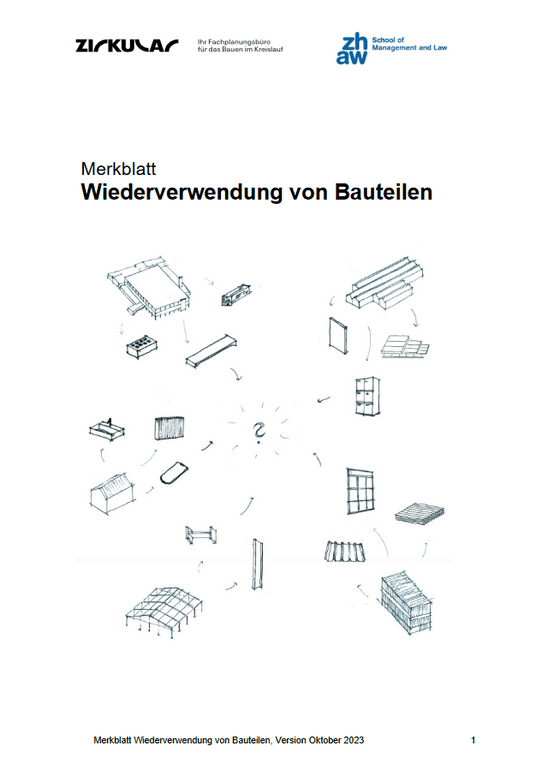
Angst, M.; Feri,V; Oefner, A.; Ott, C.; Streiff, O.; Zoller-Eckenstein, A. (2023) Language: German
This data sheet "Reuse of building components" serves as a guide for construction specialists and clients, and forms an important basis for circular construction projects. It brings together the knowledge gained from pioneering work on the benefits and processes of reusing building components, and explains which key legal aspects need to be taken into account.
The data sheet was drawn up as part of Innosuisse project no. 55734.1 IP-SBM "Reuse of building components: legal framework" in collaboration with Zirkular GmbH and the Zürcher Hochschule für Angewandte Wissenschaften ZHAW, School of Management and Law, Fachstelle Städtebau- und Umweltrecht.
De Wolf, C.; Raghu, D.; Sentic, A.; Fivet, C. (2023) Language: English
This report highlights the needs of practitioners in implementing the circular economy in the AEC sector in Switzerland, and how digital platforms can help them. We held two workshops with professionals from the Swiss AEC sector to find out what they need from science, government and industry to drive such change.
SZS (2021) Language: German / French
The new guide in the "steelaid" series from the Swiss Centre for Steel Construction SZS provides information on what to consider when reusing steel elements, load-bearing structures and constructions. The reuse of steel building components or entire steel structures is an excellent option for the ecological optimization of steel structures.
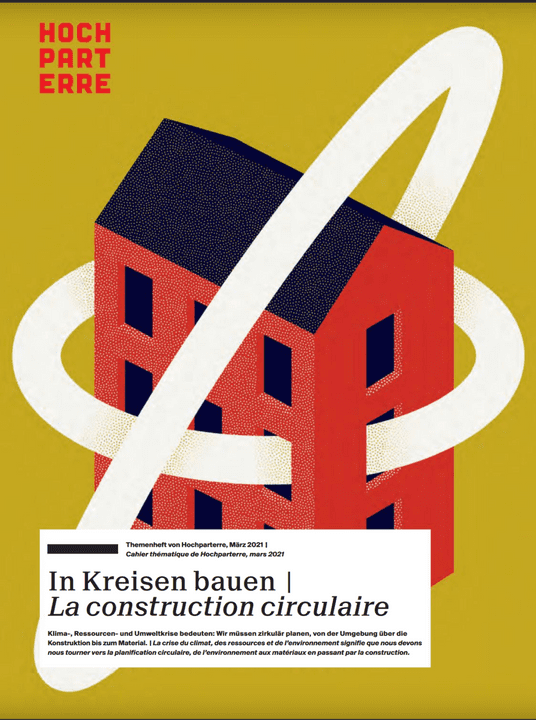
Hochparterre (2021) Language: German / French
We need to build differently. The climate, resource and biodiversity crises make this clear. And that means we need to plan and think in terms of circles that generate as little greenhouse gas, waste and other environmental problems as possible. This booklet shows on three levels - environment, construction and materials - what this means for planning and architecture.
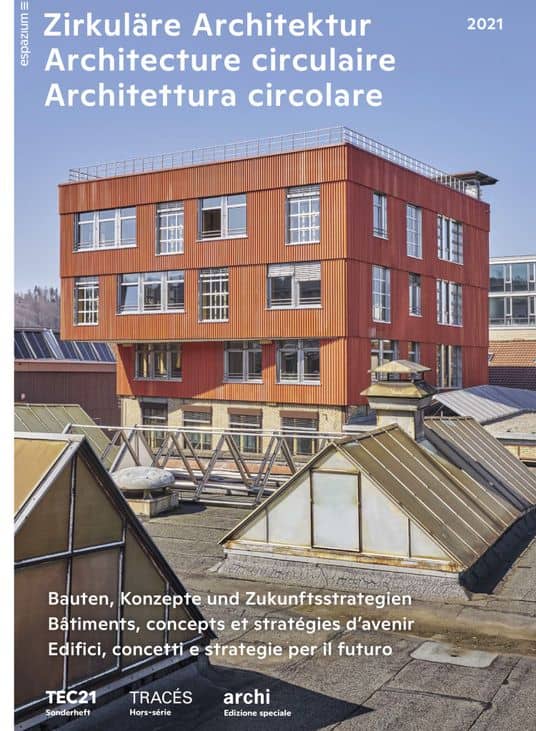
espazium (2021) Language: German / French / Italian
The "Zirkuläre Architektur" booklet, commissioned by the Federal Office for the Environment, gives an idea of the diversity of the circular economy theme. The published architectural examples include conversions - which are often the most sustainable solution, thanks to their conservation of embodied energy - as well as new buildings, which show what the circular architecture of the future should look like.
Küpfer C., Fivet, C. (2021) Language: German, French
Based on bibliographical research and 32 case studies and interviews with professionals, this compendium: " summarizes the basic principles of both approaches; " documents and shares feedback and best practices; " provides technical references for construction companies, designers and project owners; " offers a current and detailed theoretical background as well as references for future developments; ' outlines development and implementation possibilities for Swiss constructions.
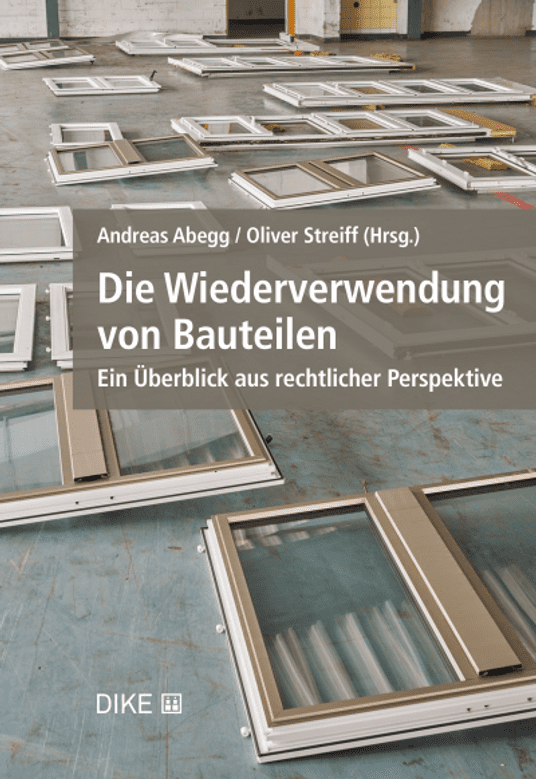
Abegg, A., Streiff, O. (2021) Language: German
Whether demolition concrete is granulated and used as a base for recycled concrete, or entire windows are removed from an object to be demolished and installed in another building, the difference is significant, according to different perspectives. This collection takes up these different perspectives, highlighting both the public and private law frameworks for the reuse of building components. It also highlights open questions and the need for further research. The results provide not only lawyers, but also building owners and planners with a practice-oriented overview of the topic.
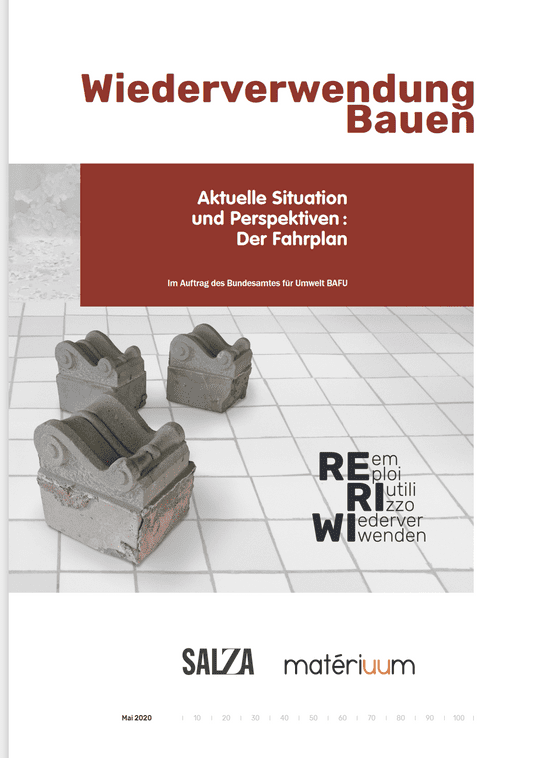
de Perrot, O., Massard-Friat (2020) Language: French, German
To examine the potential of reusable building components, the Federal Office for the Environment commissioned a study from Salza Sàrl and Matériuum, a Geneva-based building components company. Result: reuse can find its place in the construction sector. The authors of the study propose to integrate reuse into vocational training programs, and to publicize and document architectural and design services in the field of reuse, as well as the corresponding construction projects. Policies should support and consolidate reuse in the construction sector. Finally, reuse service providers need to be organized more efficiently.
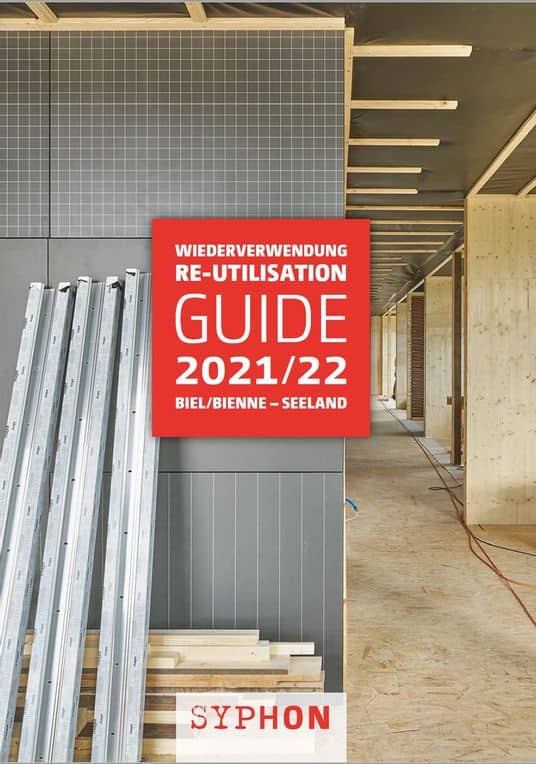
Syphon AG (2021) Language: German, French
This brochure is a kind of prototype, with no claim to completeness, but already containing many practical suggestions. The first part focuses more on the reuse of components, the second extends the subject to all possible areas in the Biel-Seeland region, and the third part is the 2020 annual report of the Syphon AG component exchange.
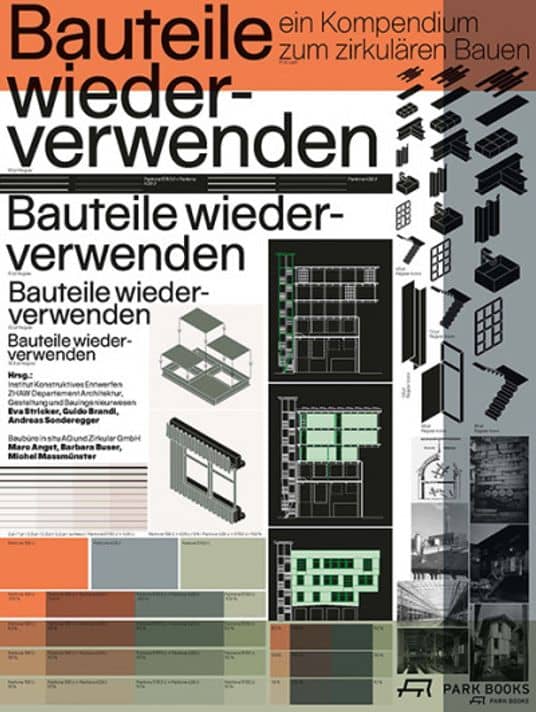
Published by Institut Konstruktives Entwerfen, ZHAW Department of Architecture, Design and Civil Engineering; Eva Stricker, Guido Brandi, Andreas Sonderegger; Baubüro in situ AG, Zirkular GmbH; Marc Angst, Barbara Buser, Michel Massmünster (2021) Language: German
This book offers a comprehensive compendium that examines in detail all issues relating to the reuse of building components. They are reviewed with the help of a concrete example: the K 118 flagship building on Winterthur's Lagerplatz, Switzerland's largest building to date, composed for the most part of reused building elements. Since 2018, this unique pilot project has been evaluated in an interdisciplinary research project with regard to architectural and constructive, energy, economic, procedural and legal issues. All the results are brought together in this book and presented in an extremely clear manner, both in terms of content and visual presentation.
Deweerdt, M., (BBRI) & Mertens, M. (Brussels Environmnent) (2020) Language: English
This document provides guidelines for carrying out a recovery audit.
A recovery audit is an action carried out in buildings destined for partial or total demolition. Its aim is to identify building materials and products with a high potential for reuse. The result of this audit is a "rehabilitation inventory" in which the identified reusable building components are listed. The resulting inventories contain information on the characteristics of the materials and products, such as dimensions, quantities, conditions, environmental impact, technical characteristics, dismantling recommendations, etc. This manual presents a method for carrying out these audits. It is aimed at construction professionals and all those involved in the (de)construction process: owners, contractors, architects and engineers, etc.
Urban Agenda Partnership, Funded by the European Commission (2019) Language: English, Italian
This handbook can be a useful tool for laying the foundations of a comprehensive strategy to implement a new model of urban reuse based on the principles of the circular economy. The book aims to stimulate and encourage strategic planning at urban level, particularly by public authorities, but also with the support of regional and national levels. Thanks to the handbook's comprehensive overview and analysis of best practices in urban reuse, cities can learn about the different solutions that can be adopted, taking into account their specific urban planning features. The approach could be bottom-up or, conversely, top-down, and different governance models could be applied to address specific situations.
Morgan, C., Stevenson, F. SEDA (2005) Language: English
Planning deconstruction details at the start of a project allows a building at the end of its life to serve as a resource for the next one, helping to close the resource use cycle. The general guide focuses on the idea of practical reuse and should be read in conjunction with other guides on sustainable design, deconstruction and recycling to create an overall design framework. The details shown have been fully calculated, tested and subjected to a defect liability check. They are proposed as viable alternatives to standard details and illustrate the possibilities for reuse.
Standards are an important tool for facilitating cooperation and communication between the various links in the value chain. They can also be a useful tool for governments to establish clear rules and regulations. Similarly, it can be useful for private sector companies to set up standards on a voluntary basis to measure and communicate progress in CO2 reduction and circular construction. In the list below, we have listed mandatory, voluntary and proposed standards.
In this standard, the term project owner also includes the planners and other specialists it has commissioned, and the term contractor also includes the subcontractors and suppliers it has commissioned. Report containing information on waste sorting, waste categories, quantities and pollutant load, as well as planned disposal routes.
The SIA 101 "Order of services of the project owner" defines what it means to be a project owner, and the obligations and activities incumbent upon him. As a common standard of understanding, this ordinance - or extracts from it - can be incorporated into contracts as a contractual element.
It is aimed not only at project owners, but also at their contractual partners such as planners, contractors and consultants. It aims to clarify the interfaces between the various parties involved in each phase of the project, thus contributing to its success.
SIA 101 is based on the SIA 112 "Model - Construction Planning". It adds phase 0 "Initialization" and specifies the services and decisions expected of the project owner in each phase of the process.
Once the construction work has been completed and the structure commissioned, the main phase in the life cycle of a building or facility begins: use. This is accompanied by management and maintenance, essential to preserve the value and functionality of the structure for as long as possible.
Although buildings are not built for eternity, they generally have a lifespan of at least several decades. This depends not only on the quality of the workmanship, but also on maintenance and the building's ability to adapt to changing needs. These aspects must already be taken into account during the planning phase.
In addition, the possibility of dismantling the structure and reusing materials plays an important role in its life cycle. Thoughtful planning and execution, involving all stakeholders around common objectives, help reduce costs and the consumption of natural resources, while improving quality.
This is in line with the SIA's vision: "Our goal is a sustainable, quality living environment that looks to the future. This is where we focus all our efforts.

Campanella, D.; Pietsch, R.; Dünger, O.; Sauer, S.; Mettke, A.; Schmidmeyer, S.; Teuffel, P.; Baitinger, M.; Kroll, B.; Mees, K. (2023)
Language: German, English
DIN SPEC 91484 defines a method for collecting information on construction products as a basis for assessing their reuse potential prior to demolition or renovation work. The aim is to ensure that all market players have a sufficient and uniform level of data at every stage of the value chain.
The scope of application covers constructions in accordance with §2, paragraph 1 of the MBO (Model Building Ordinance). The standard specifies requirements for information gathering, the target document, the process, the players involved and the tools used. The information compiled serves as a guide for carrying outPre-Demolition Audits (PDA).
A uniform data format is targeted for the exchange of results, to ensure compatibility with other existing systems or formats.
This report proposes a general framework for circular buildings and suggests concrete strategies and indicators for possible integration into the BREEAM New Construction and Refurbishment & Fit-Out (NC & RFO) standards.
It has a dual objective: firstly, to provide stakeholders from the public, economic and scientific spheres with a basic framework for the circular economy approach applied to buildings; secondly, to accelerate the transition to a circular built environment by proposing strategies and indicators suitable for integration into global reference standards for sustainable construction, such as BREEAM.